A=sec^-1sqrt5,B=1/2 sin^-1(p/q), C=sin^-1r,f(x)=sinalphax,g(x)=sinbetax
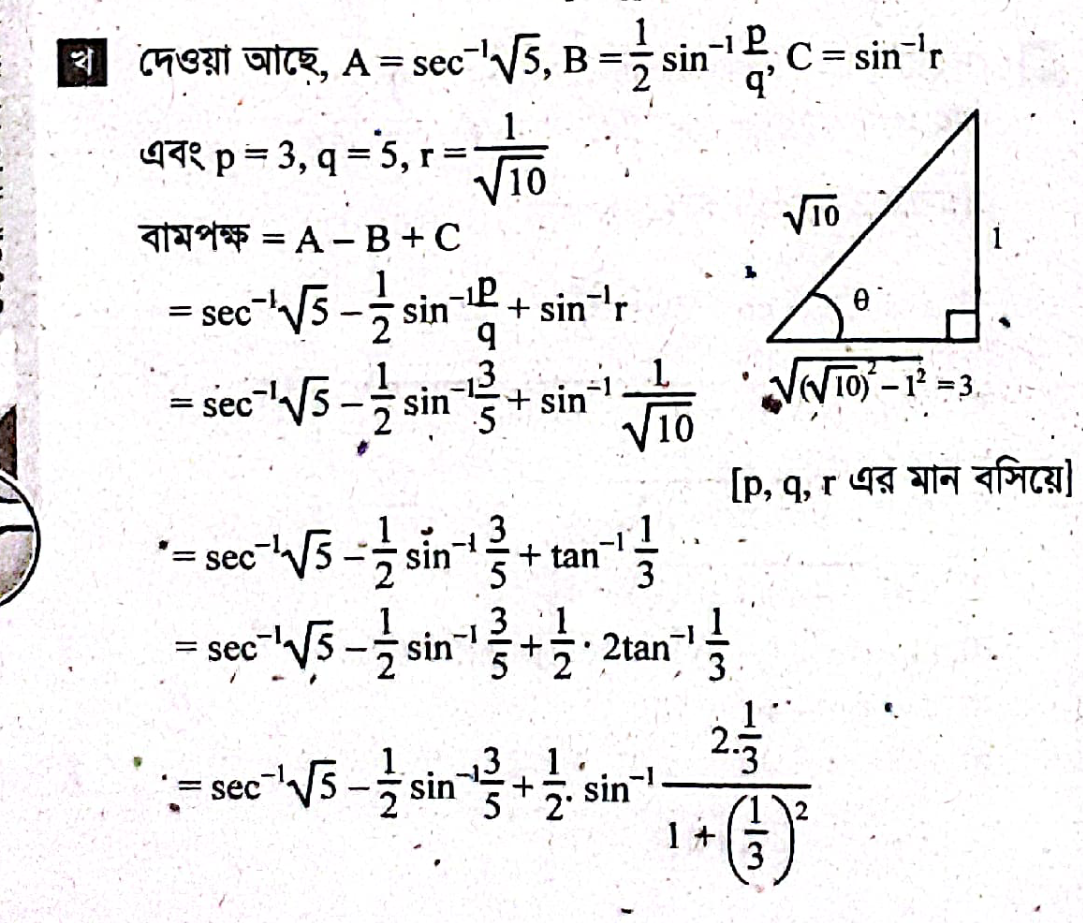
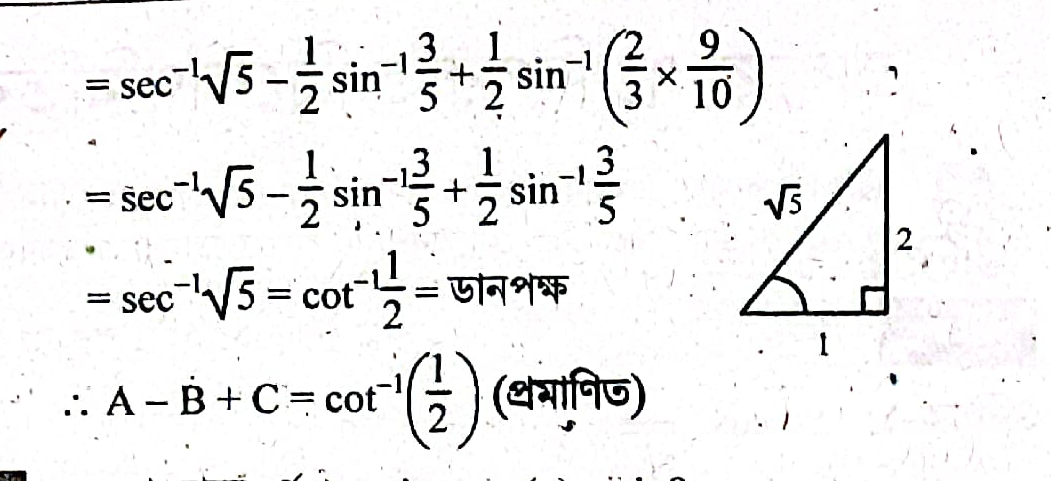
p=3,q=5,r=1/sqrt10হলে, প্রমাণ কর যে, A-B+C=cot^-1(1/2)x2 +y2 =1
A.
B.
C.
D.
উচ্চতর গণিত দ্বিতীয় পত্রবিপরীত ত্রিকোণমিতিক ফাংশন ও ত্রিকোনমিতিক সমীকরননির্দিষ্ট ব্যবধিতে সমীকরণ সমাধান (Topic Practice)

Explanation:
Related Questions (Any University/Year)
- tan^-1sqrtx=1/2cos^-1((1-x)/(1+x))
- tan^-1(1/3)=?
- উদ্দীপক: f(x) = sinx এবং g(x) = cosx.A=sin-13/5 B= cos-1 5/13 C=cot-12 D= tan-128/29উদ্দীপকের আলোকে প্রমাণ কর যে, 2A + B = 2(C+D).x2 +y2 =1
- দৃশ্যকল্প-১: f(x) = √2x²-3x+√2.দৃশ্যকল্প-২: A = 2 sin^-1 (1/3)+cos^-1sqrt(2/3) দৃশ্যকল্প-২ হতে প্রমাণ কর যে, A=tan^-1(5/sqrt2) x2 +y2 =1
- sec2x−2√3 tanx+2=0 হলে, (0<x<π/2)ব্যবধিতে x এর মান-
- sincot^-1 tancos^-1(3/4) এর মান কত?
- x=sincos-1 y হলে x2+y2 এর মান হবে-
- tan cos^-1 sin cot^-1 (3x^2) - 1 = 0 হলে x. এর মান কত?
- N = tan-1 (cosec tan-1 x- tan cot-1 x) এবং f(θ) = cos θ দেখাও যে, N=1/2 tan^-1 x x2 +y2 =1
- sin(π/2 -cos^-1 x) = cos(cos^-1 x)=x কত?
- cot(cos-1(1/2)) এর মান নিচের কোনটি?
- sin^-1(4/5)+cos^-1(2/sqrt5)=?
- বিপরীত বৃত্তীয় ফাংশনের ক্ষেত্রে, tan^-1x + cot^-1x=π tan^-1 (x/sqrt(1-x^2))=sec^-1 (1/sqrt(1-x^2)) cos^-1x+cos^-1y= cos^-1{xy-sqrt((1-y^2)(1-x^2))} নিচের কোনটি সঠিক?
- cot⁻¹(x) = 0 হলে, tan⁻¹(x) = কত?
- উদ্দীপক-১: M = cos^-1 (1/sqrt5)-1/2 sin^-1 (3/5)+tan^-1 (1/3)উদ্দীপক-২: f(x) = sin x ও g(x) = cos xউদ্দীপক-১ হতে দেখাও যে, M এর মান x2 +y2 =1
- sin^2(cos^-1 (1/sqrt3)) এর মান কোনটি?
- দেখাও যে, 2 tan^-1x=tan^-1 2x/(1-x^2) x2 +y2 =1
- sin−1x=cot−1(1/2) হলে x এর মান কোনটি ?
- Sin(tan^(–1)(1/2)+cot^(–1)3)=?
- sin^-1(2/sqrt5)+tan^-1 x=(pi/4) হলে x এর মান কত?
- cos-1x +cosec-1 (1/x) =?
- cosec2(tan−11/2)−sec2(cot−1√3) এর মান নিচের কোনটি?
- cot2θ-3+1 cotθ +3=0, 0<θ <π2,θ = কত?
- f(x) =cot (π/2-x) এবং g(x) =sin-1xপ্রমাণ কর যে,g(1/sqrt5)+ g(1/sqrt10)= π/4